Saturday, November 17, 2007

Tip

Hey. I've been real busy lately, but here's a fun tea-tip:

Sencha:
  • Brewing at a higher temperature brings out more aroma, but more astringency as well.
  • While brewing at a cooler temperature bring out a sweeter flavor, but less aroma.

Friday, November 2, 2007

Aura Baozhong. Adagio Baozhong.

I received a few samples of tea from Aura Teas today.


Among them was this Formosa Wenshan Baochong.


The dry leaf smells like a lightly oxidized "green oolong" It reminds me of Adagio's pouchong, but with less of the earthy smells. After thinking about it for a minute, I realized that both these teas are really Baozhong. Baozhong is a variation of oolong that is lightly oxidized, producing a green, sweet cup. Both Aura's and Adagio's originate from Taiwan. There are Chinese-grown baozhongs, but I believe these should probably be avoided, just like Chinese senchas.

For a long time, my favorite teas were these kinds of lighter oolongs. Probably because they are predominantly sweet, and very forgiving in their steep time. One day I got a stomach ache after drinking some. Then again the next day. I decided to let it rest for a while, and never really got back into the green oolongs. Today I'll try these two Baozhongs from Adagio and Aura.


Baozhong
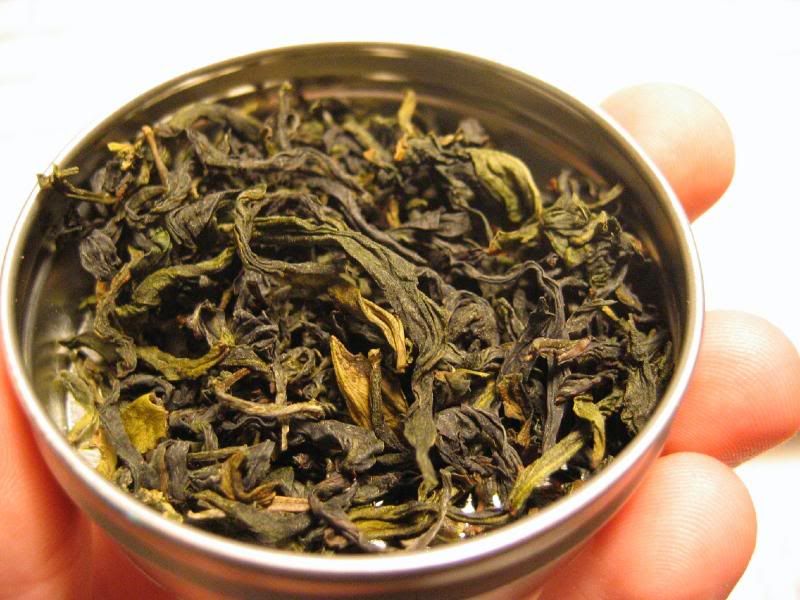
Aura's:


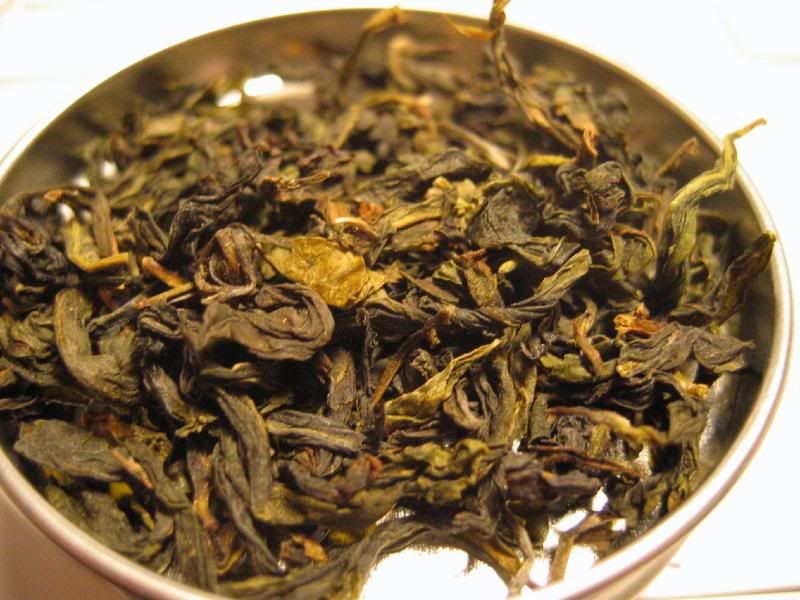
Adagio's:


The dry leaf of Aura's smells sweet, in the way that green oolongs do, and lightly earthy.
In contrast, Adagio's has a bit of a deeper sweet in the smell, while also smelling much more earthy.

I brewed them both at about 1 layer of leaves on the bottom of my 125 mL gaiwan at 190° for 3 minutes, not according to any instructions. By the way, with large leaf teas like oolong, it can turn out that you can only fit 1 leaf on a teaspoon, so they often require either weighing, or just a good visualization.


Aura


Aura's smells honey-suckle sweet. Lightly floral.
The taste is very nice. Having good balance of floral sweetness while being very smooth.
I was surprised by the 2nd infusion here. As always, the first infusion wakes up the leaves after having been dried. The second infusion had a nuance of a smoky smell, similar to gunpowder.
The taste turned out quite pleasant, with a more rounded flavor, losing any sharper floral notes to the deep sweetness. The taste still has an airy floral quality to it.
The third steeping is still tasty, but very rounded off.


Adagio


In order to compare, I used the same methods as with Auras.
The tea's fragrance is much stronger than Aura's. It smells a bit less sweet while putting off a sharp floral montage, as well as a heavy earthiness.
The taste is very earthy. I would call it a sweet, floral earthiness because it is predominantly earthy. The flavor is not that pleasant.
The 2nd steeping smells less earthy and more sweet, with deeper floral notes. The taste, however, has become predominantly floral, with a heavy backing of sweetness.
The 3rd steeping is a bit "off." Tasting seperate floral, earthy, and sweet flavors.


Retrospect
The Pouchong from Adagio was not as pleasing. It was very obvious that this earthiness was no good and that the pouchong was simply not well-rounded. In truth, Aura's Baozhong arrived today, and I received Adagio's baozhong a couple months ago. Although I ordered Adagio's right when they got it in, you never know how long its been in the chain from Asia to America.

Recommendations
Both teas would be great as an introduction to Baozhong, or to green oolongs in general. Pouchong was my favorite tea during my first few intiation months into the world of tea. Adagio's might be better if you're looking to pick out the different qualities of a baozhong, as the flavors are not blended together, but I believe Aura's is more pleasing. In my opinion: because it's flavors are blended together, which allows it to be easily perceived as a whole, while Adagio's flavors are seperate, which may leave someone to wonder what a baozhong is really all about.

Aura's tea shop can be found here
.

Adagios tea shop can be found here
.

Saturday, October 27, 2007

Organic Wuyi Qi Lan

I don't know much about Wuyi tea, or oolong tea in general. I am more of a green tea drinker. It's the scenario of needing a darker tea in the morning that leads me down the path to wuyi. Put simply, oolong tea is a halfway tea between black and green. It is more oxidized than green, but the oxidation process is stopped before it becomes black tea. Other processes that make oolong what it is could be brought on by a roasting process. Wuyi oolong is tea from the Wuyi Mountains of China.


Wuyi tea's individuality is said to be caused by the rocky soil and microclimate of these mountains. This is of course in addition to the tea varietal that grows there.


Wuyi tea is good in the morning because it carries a bigger kick of caffeine, has a more complex flavor variety, and is shrouded in sweetness. It is also very easy on the stomach, allowing me to drink it before any kind of breakfast, like today. I also have black teas in the morning sometimes, but the reason I like to have wuyi is because of it's complexity of flavor, and the lower amount of caffeine. For me, I seem to drink black tea mostly for the caffeine, while wuyi gives me both the caffeine, and the flavor.

I have only tried 3 different Wuyi teas. One from Adagio, which was a good introduction, another I got in a tasting pack from puerhshop, which was heavily fired, and thus a little intense. The third is Rishi's Organ Wuyi Qi Lan.


Rishi's Qi Lan is my favorite of the three. It is more complex than Adagio's, and less intense then Puerhshop's. On to the tea:


The aroma of the dry leaves is very pleasing. Getting the dry smell from the leaves is hard. What I do is take a small amount of leaves, and place them in the palm of my hand, the moisture from my hand releases the aroma of the leaves. The aroma given off is a deep, roasted-sugar sweetness, along with some roasted raisin-like complexity.

I put enough leaves to cover the whole bottom of the small yixing pot.


The brewing parameters I've been using are roughly 208°f for 3.5 - 4 minutes. But I have been told that wuyis are normally prepared with short steeps. For now, my methods are working wonderfully.


My camera is still having a hard time focusing on the tea. :(

TEA

Smell
Roasted sugar, sweet, complex. A nice dry wood fragrance, perhaps slightly barky, and accompanied a bit by the raisin-sweetness.


Taste
1st Steep
Strong and sweet, and just as the description on the bag says, a dry kick of roasted sugar. The sweetness seems to be coming from a raisin-like presence. The woody flavors, and roasted flavors are a bit intense, sharp.
2nd Steep
The tea becomes better rounded, with a less "complex" feel. Woodsy flavors are more present, and the roasted sugar flavor has blended into the rasin-sweetness. Perhaps the taste also becomes a bit lighter in the second steeping. As tea cools to a warm temperature, it becomes predominantly sweet, but the sweetness seems to be somehow "complex."
3rd Steeo
Third steeping is still very nice. Reaching a state that perhaps can not be any more rounded. Deep sweet flavors of raising and sugar have blended. The tea has become slightly lighter as well. Less woodsy flavor.

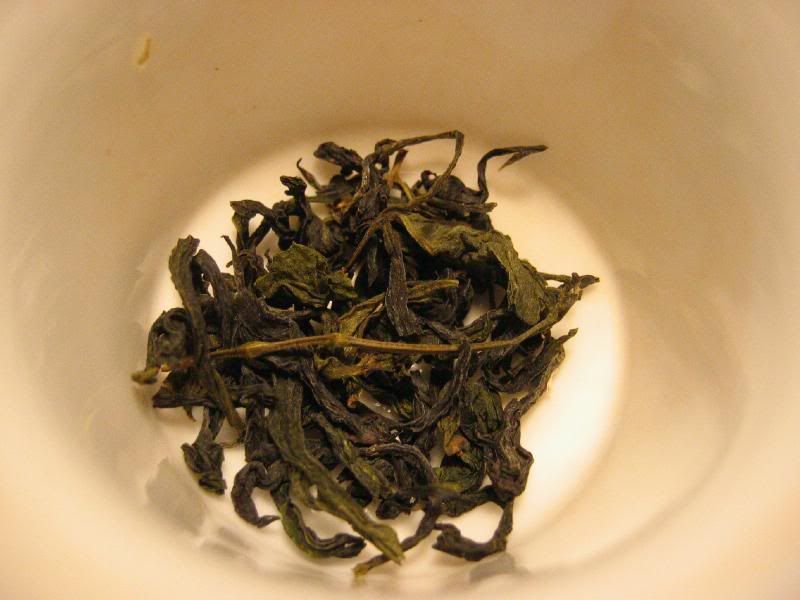
And the remnants:


As you can see in these pictures, some of the leaves are green, some brown. All the wuyis I've had have been like this. But I have been told that not all wuyis show this characteristic. This leads me to believe that all the wuyis I've had are a blend of some kind.


Conclusion
This is my favorite Wuyi. Absolutely wonderful. It is very satisfying as a morning tea. A good pick-me-up and an awesome complexion of flavors. It is this tea that may lead me to experiment more with wuyis. I recommend this tea to anyone who hasn't yet had the pleasure of trying a Wuy oolong tea. Rishi's Organic Wuyi Qi Lan is one of the most complex teas I've had the pleasure of drinking.